Fletcher Rowley featured on CNN this weekend.

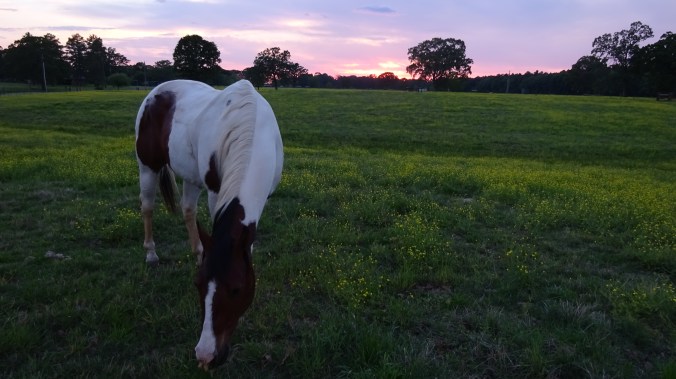
It’s late in the day. Tired. Hungry. The equipment is all loaded and the crew is ready to go eat and rest.
Then the light changes. No, you say to yourself. No, it’s just another sunset. You don’t have time.
Then the paint horse begins to walk up the pasture.
Without actually making a decision you begin to walk toward the fence. Quietly. You reach into your pocket for a camera and then for a few glorious moments you are simply lost. You aren’t hungry or tired. There’s just the light and the horse. The little yellow flowers seems to glow. The horse turns the wrong way and you get some fantastic sunset photos featuring the wrong end of the horse.
Then he turns and begins to graze toward you and the sound of his eating and chewing seems like a sound from another world. A deep crunching noise as he breaks off the sweet grass and chews.
Then something happens. The cosmic tumblers fall into place and you get just a moment where the sun, the sky, the horse and the little yellow flowers feels like they are in just the right place. One frame out of a few hundred. The last shot. One last shot.
It’s a gift. You could have been down the road a few miles but, instead, you happen to be standing there with a camera in your hands when something sweet and memorable happens. It’s a gift you give to yourself. One last shot.
A lot happened today. Hundreds of photos and hours of video. But as I lay dying years and years from now this is the image I am most likely to remember from this day. The last shot. One last shot.

I had just finished my chores when I heard the first rumbling. Long and low like the earth clearing its throat. A storm was coming.
The front of our house faced Bays Mountain in the distance. Sometimes, storms would go south of the mountain and we could just see the tops of them. But when the storms came north of the mountain then we were in for a show.
I went into my Mom and Dad’s room and got a quilt one of my grandmother’s had made and went out on the front porch. I sat in one of rocking chairs there and covered myself with the quilt.
The storm had cleared the lower hills and was coming north. When I would see the lightning bolts I would count. One. Two. Three. Four. Five. Six. Seven. Eight. Nine. Ten. Eleven. Then, a gentle boom.
Another bolt of lightning. One. Two. Three. Four. Five. Six. Seven. Eight. Nine. Ten. Then another boom. A little louder.
I would lose myself in the storms and count down the time difference between the lightning and the thunder.
Lighting strike. One. Two. Three. Four. Five. Six. Seven. Eight. Nine. Then a nice big round boom of sound. A few raindrops began to fall. I could hear them on the leaves in the woods before I could see them.
Two strokes of lightning. One. Two. Three. Four. Five. Six. Seven. Eight. Then boom … boom. One clap of thunder right after the other.
Then the lightning would be so close there was no need to count. The rain came hard. Huge fat drops of rain that splashed on the concrete of the front porch and mist that blew onto my face.
Lightning would strike and simultaneously there would be a huge crash of thunder. I was in the center of the storm. The trees whipped and thrashed as if trying to flee the violence.
The sunlight was all but gone. Lightning lit up the countryside and there were flashes of light and crashes of sound so close together they couldn’t be distinguished one from the other.
I pulled the quilt around me more tightly. I breathed in the misty air. I leaned into the storm.
My mother came to the screen door.
“Here he is,” I heard he announce to my father. “He’s watching the storm on the front porch.”
“Are you OK?” she asked.
“Yes,” I replied. “Just watching the storm.”
Then it was over. Weak light returned to the hill. Rain dripped from the leaves of the trees in the front yard.
I went back inside and put the quilt back on Mom and Dad’s bed. I always loved those storms.
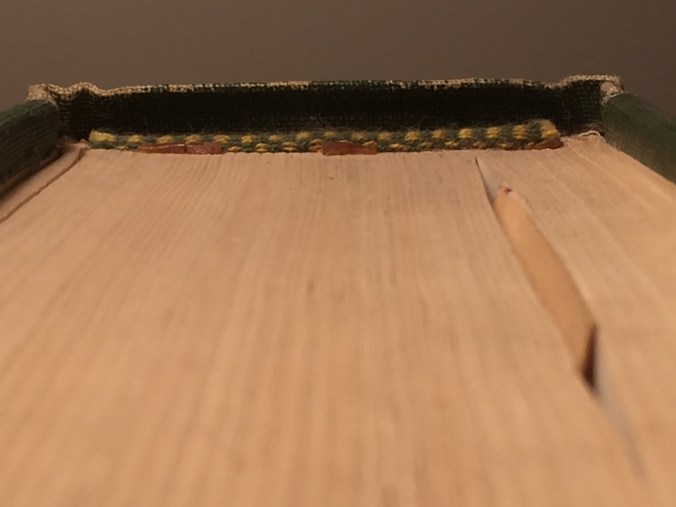
My father was a bookmaker.
He worked for the Kingsport Press. During a 30-year career he worked in every part of the making of books. Bindery. Stamping. Gathering. Printing. The plant where he worked starting in the 1960’s was one of the few in the world were a manuscript came in the front door and a book got shipped out the back.
I will always remember how he would pick up a book and examine it. He would remove the dust jacket and set it aside. He would run his thick hands over the covers and down the spine. He would look to see if the end paper was nice and square on the inside cover. He would check he headband to see that it was properly applied … or shake his head if the book didn’t have a headband … a sure sign of a shoddy book.
He would sometimes speak to us as he examined a book, incanting words and phrases in an almost prayerful contemplation. Saddle stitching, perfect binding, Smyth sewn, spot varnish, watermarks, die cuts, blind stamping, galleys, gatefolds, gutters. Heaven forefend that someone would open a book and crack the spine so it would lay flat. If a perfect stranger did that in his presence they would get a lecture.
My father was a bookmaker. He could not abide a shoddy book with thin paper, bad printing or imprecise gutters.
These days I mostly read books on a variety of electronic devices or as audio books. I have never lost the appreciation of a well-made book. My wife and I have a small but well tended library. I sometimes go in there to write letters or read or think. There is something permanent about a book. Something noble. Something hopeful. A book is civilization saying, “This is important. This will last. Read this.”
A woman in Hong Kong
Buys a lemon
Her hair is straight
And unperfumed
Held around her face
By a cheap plastic beret
Made
In Hong Kong
A source of pride
She also buys
A mango
Some rice
And a small bottle
Of rice wine
But it is
This lemon
That’s important
For the first day she will simply
Enjoy the smell of this lemon
And then
She will cut it
Into paper thin slices
For her tea
And collect the juice
For her hair and body
Because
The smell of this lemon
Will last
For days
And her husband
Likes the smell of lemon
In Amsterdam
Her daughter
Will sit
In a smoky bar
Her Mandarin cheekbones
Framed by fake blonde hair
And men from around the world
Will come and watch her
And when she goes home
Early in the morning
The only thing that will
Cut through the smell
Of smoke and whiskey
Will be
The juice of a lemon
She bought in town
Because it reminded her
Of her mother
To whom she has not spoken
In three years
Four months
And sixteen days
One man
Will see the young woman
And through mystical connections
Forgotten in the modern world
Be made to understand
The connections
And he will walk out
Into the clean air
For he cannot bear to
Watch these women
And the drunken fools braying at them
He will write it all down
And these images
Will haunt him for many days
And he will try to explain it
To those whom he loves
And some will understand
And others will not
But all of them
Will marvel
At this
And no one will ever
See a lemon
The same way again
Bill Fletcher / 2007 / Amsterdam
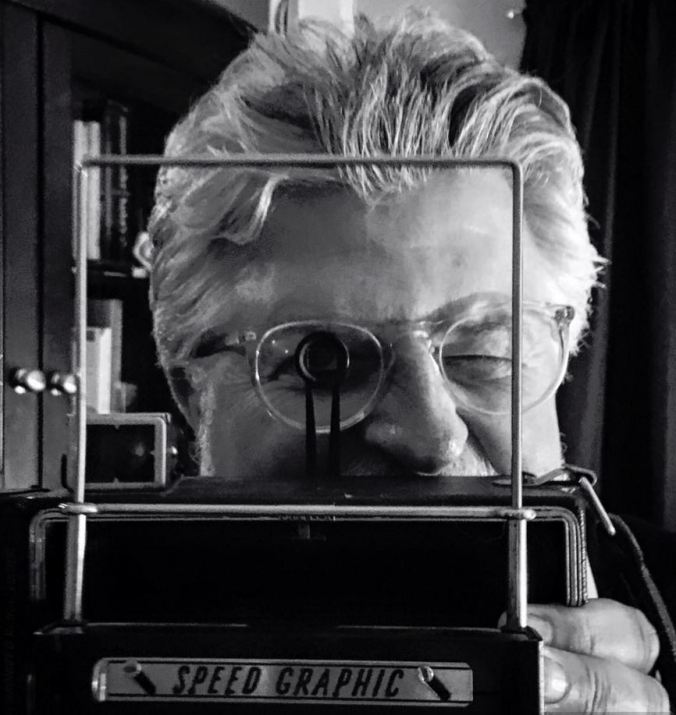
My friend Jim Will shot this photo of me last night while I was demonstrating the “sports viewfinder” on my Speed Graphic. This camera was in wide use by photographers from the early 1900’s until the 1970’s. It used 4 x 5 inch sheet film. A wonderful camera. I have actually used this camera to make large format photographs.

My friend Steve Davison is an interesting man. A cinematographer, producer, and director. A furniture maker. Quick with a joke and dead serious in the next instant.
On shoots, at about three o’clock in the afternoon, he gets a little testy. It can be alarming to someone who doesn’t know him. Those who do know him treat his moods like afternoon rain storms in the summer … to be briefly endured and fondly remembered.
A few years ago, he shared his gumbo recipe. My favorite line in it is “drink beer and watch football during this part.”
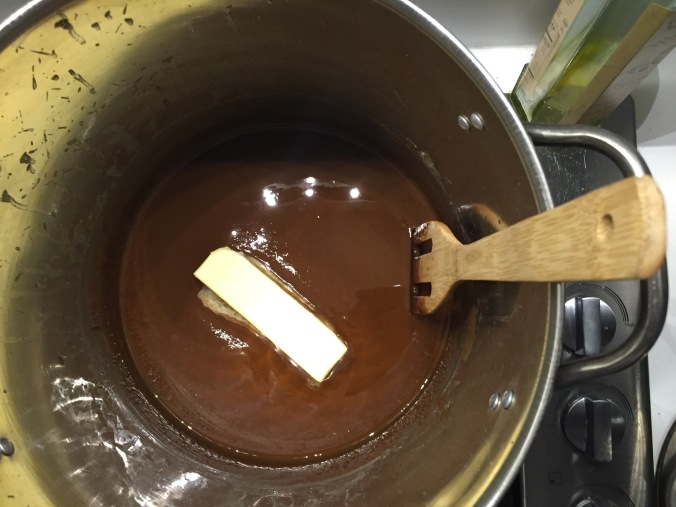
A couple of times a year I make Steve’s gumbo and I recall the many good times we’ve had together. Our many adventures and shared friends and those no longer with us. Tonight, after I made the most beautiful roux I have ever made, I wished Steve had been here to see it. It was lovely. The color of a rusty nail. Creamy, rich and fragrant. Ruby and I will enjoy this gumbo for many days and perhaps share it with others. Steve will enjoy it as well although he won’t be having a bowl unless he jumps a plane to Nashville for that purpose.
Steve is my friend for many reasons but perhaps this is the most important one. Steve takes his gumbo very, very seriously. I like that in a man.

We used to raise pigs on our small farm in East Tennessee. When the mother pigs had babies they were called a “litter.” There would be anywhere from 10 to 12 pigs in a litter. But sometimes, there could be more.
One cold spring night, one of the mother pigs gave birth to 21 baby pigs. When baby pigs are born they come around to the mother’s belly looking for something to eat. This mother didn’t have enough nipples for all her babies. So, the little pigs started walking around in the pig barn looking for something to eat.
When I came to the barn the next morning I opened the door and, to my surprise, there were little pigs everywhere. And they were hungry. I ran up the hill to our house to tell my brother and sister to come and help me catch all the pigs. We went back to the barn, caught all the little pigs and put them in the pen with their mother. We helped each pig get something to eat and we thought everything was fine. We counted all the little pigs and we found that there were 20.
It was very cold on this morning and there was frost on the grass. I had to walk over to another barn to feed some calves we had there. One my way to the barn I saw something in the frosty grass. It was a little pig. It had gotten out of the barn in the middle of the night while it was looking for something to eat. I picked the little pig up. It was stiff as a board. I thought it had frozen to death. I pulled off my gloves and held the pig in both hands. I wasn’t quite sure what to do with it. As I thought about what to do I thought I felt something in my fingers. I stood very still and I held the little pig close to my body and held my own breath. I felt it again. It was a heartbeat.
I took off running back to the house with the little pig. I went into the house with that little pink pig and told my mother what had happened. She took the pig from me and said, “This poor thing. Let’s see what we can do.” She got a big fluffy towel and wrapped the pig in it. Then she surprised me by opening up the door of the oven and putting the pig inside. She left the door of the oven open and turned on the heat very, very low.
We waited. We could feel the heat from the oven coming out into the kitchen. I could not take my eyes off the little pink pig, wrapped in a towel and lying on a rack in the oven. All I could see was the tip of the pig’s nose.
First, I thought I saw the pig move under the towel. Then I saw the nose move. Then I heard a little muffled grunt coming out of the towel. My mother reached into the oven and picked up the pig and it grunted and squealed and began to squirm in her arms. The pig was alive.
We became very attached to that little pig. We kept it in a small building near the house for a few days. We fed it milk from a bottle like a baby. We kept it in a cardboard box with a towel in it. After it got a little bigger, we kept it in a dog pen in the side yard. When the pig was big enough to eat solid food, we took it down to the pen to be with the rest of the pigs.
I thought that pig would be happy to be reunited with its mother, brothers and sisters. But that pig was so mad that we put it in that pen. I think that pig believed it was a human being or, at least, that it belonged at the house and not in that pig pen. It stood at the gate of that pen and squealed to be let out.
That pig never did act like a regular pig. It wouldn’t eat with the other pigs. It wouldn’t pile up in the shade and sleep with the other pigs. That pig was a loner who acted like he was too good to be with the other pigs. Even up until the day we took the pig to market to sell, it never acted like the rest of the pigs. I also suspect it never forgave us for making it stay in the pig pen.
I’ve often thought how lucky that pig was that I took that particular path through the field that day and I’ve never forgotten how my mother’s country common sense saved that pig’s life.

